Movement HabitsPain Relief
How Changing My Movement Habits Accidentally Caused More Pain
17. září 2021
6 min read
Updated 4. 6. 2026
MF
Martina Fallerová
Movement & Wellness Expert
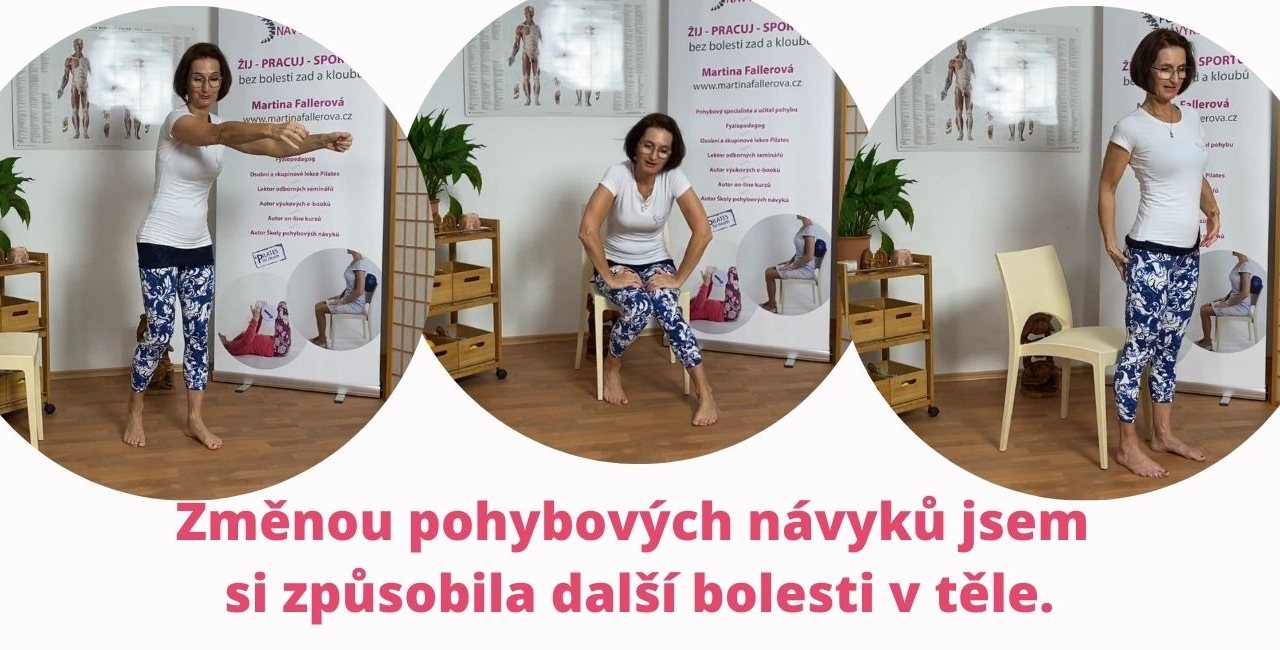
Last week in our School of Movement Habits Facebook group, we opened up a discussion on a crucial topic: Should we straighten our bodies? Align our posture? Correct our movements?
Does it help? Does it do harm? What works for one person might be detrimental to another.
I'm a firm believer that it's vital to listen to your body and respond to its signals before it gets truly upset. Once pain sets in, the path to recovery is often longer and demands a lot more of our time and energy.
I founded the School of Movement Habits based on a core observation: whenever a client comes to me with musculoskeletal pain, the key to successful and lasting therapy lies in addressing posture, joint centration, and how they use their body in daily, work, and sports activities. You can read more about this philosophy in my article, Heal Your Body by Changing Your Movement Habits.
If I only gave a client exercises and didn't focus on how they use their body throughout the day, they would just keep coming back with the same problems. They’d be stuck in a vicious cycle.
The Right Order of Operations
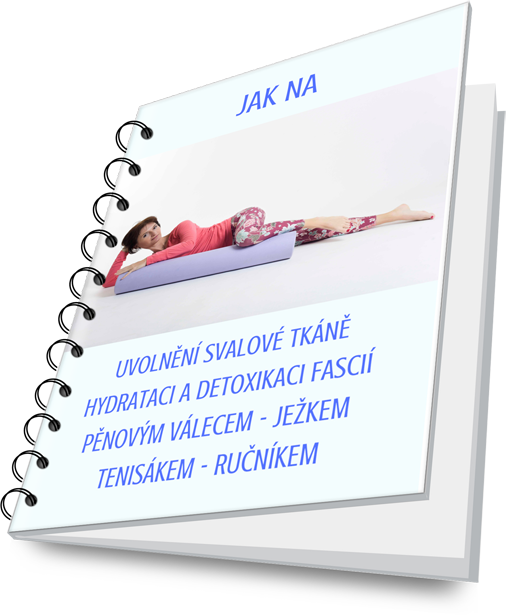
For a client to successfully align their body and center their joints, it's essential to first prepare the tissues, muscles, and the fascial system. This can be done through self-massage, Rolfing, soft tissue techniques, and functional stretching. Only then can I effectively guide the body toward proper alignment, centration, stabilization, and functional strengthening. The final step is to integrate these new patterns into daily and work-related activities.
If the body is tight and we try to force it into alignment, what often happens is that a correction in one area throws another part of the body out of balance. In doing so, we risk creating new problems elsewhere.
It’s crucial to do everything within your individual limits and to respect your body. Never push to your absolute limit in any movement. Always leave a little bit of room in every joint and motion. Hold positions actively—don't just hang on your joints.
But what if a person isn't in pain? If their body is doing great, why should they interfere with it? For prevention? Well, that's the question.
Real-Life Examples: When Correction Makes Sense
The question of whether to correct or not still rattles around in my head. Let me share a few stories.
My Husband's Knee
When my husband had problems with his knee, he did all the right things: releasing tight tissues, stretching, and strengthening, just as I teach in the online course "Restart Your Body" and the "A Pain-Free Body" online library.
However, when it came to correcting his walk, he didn't bother. He still stomps and pays no mind to his foot strike. If I had demanded he also change the way he walks, it would have undoubtedly taken a toll on other parts of his body. It would have been too much for his system to handle at once.
What did help his knee was ski touring—specifically, the uphill climb. This movement naturally ensures the alignment of the second toe, knee, and hip. The skis guide the lower limbs correctly, which is fantastic. For the descent, he would take the cable car or bus down—a convenient option from Hvězda under Praděd. Now that his knee is fine, he was even able to ski downhill by the end of last winter.
Movement is medicine. You just need to figure out the right intensity and ensure it's safe.
My Husband's Elbow
When he had persistent elbow pain, we tried to trace it back to its source—a specific movement, position, or something he was doing repeatedly.
Ultimately, it was his sleep posture. He was constantly sleeping with that arm bent and was even lying on it. He started to become more aware of his arm before falling asleep, consciously straightening it and avoiding putting pressure on it.
And the elbow pain went away.
A 78-Year-Old Man's Knee
Recently, I worked with a 78-year-old man suffering from knee pain. All it took was watching how he walked and asking how he sits in front of the TV.
His painful leg would land with a "locked knee." The joint was pushed to its limit, and he wasn't using the muscles around it to absorb the impact. I taught him to add a little spring to his step as his foot landed. The knee is a natural shock absorber, and this is how we should use it.
When watching TV, he would rest that same leg on a coffee table, with the knee hanging in the air, locked once again. My recommendation was simple: prop it up with a pillow. For homework, I gave him a resistance band and exercises from the A PAIN-FREE BODY online library to strengthen the attachments around the knee. You can find more on this topic in the article 7 Tips for a Functional, Pain-Free Knee.
The Verdict: Motivation Matters
In cases like these, correcting and adjusting daily movements makes perfect sense.
The motivation is there: there's a problem that needs to be solved.
If the body is doing well and there's no pain, then the question of whether to "fix" or "correct" it becomes much more nuanced.
I'd say it depends. For instance, hanging on one hip while standing is something I would definitely address with everyone. The long-term benefits of correcting that habit are clear.
But in other situations, why interfere? It's truly individual and always depends on whether the person is ready for change—both mentally and in terms of their physical tissues—and what their bones and joints will even allow. If I'm living with joy and surrounded by positive people, my posture will be completely different than when I'm tired, stressed, and around negativity.
❓ What's your experience?
❓ Has a specific movement or posture correction helped you?
❓ Share your story with me. Ask any questions you have about this topic in our School of Movement Habits Facebook group.
Tags
#posture#body awareness#pain management#movement correction#fascia#knee pain#elbow pain