Back PainFasciaMovement HabitsStabilityBreathwork
5 Steps to a Pain-Free Body with the FASPO Movement System
2. července 2024
11 min read
Updated 4. 6. 2026
MF
Martina Fallerová
Movement & Wellness Expert
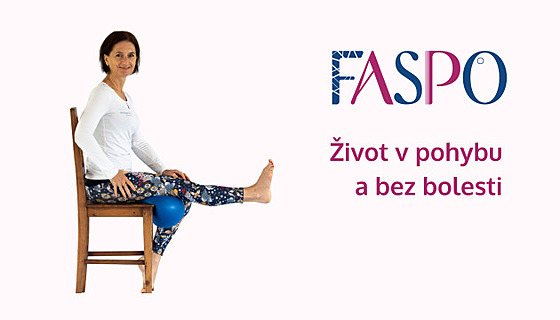
Why does back pain keep coming back? Why do you feel a sharp pain in your knees or hips? Often, the source of pain is far from where you feel it. Let's explore the fascinating connections within our bodies and learn how to not only eliminate pain but prevent it from returning with the unique FASPO method.
Fascia: The Hidden Culprit Behind Your Pain
Do you suffer from recurring pain in your back, knees, hips, or shoulders? Fascia could be the hidden culprit. Thanks to the body's intricate fascial network, the source of your pain is often located somewhere entirely different from where you feel the discomfort.
Fascia refers to the soft components of connective tissue that weave through the entire body like a flexible web, enveloping and connecting everything.
In simple terms, you can think of fascia as a large shopping bag (the outer, overall container) holding individual items (organs, blood vessels, nerves), each of which also has its own separate wrapping.
Imagine going shopping where the cheese has no wrapper, the honey isn't in a jar, the roll has no crust, and the orange lacks not only its peel but also the thin membranes around each segment. You'd have to carry home a jumbled mess in your bare hands.
Fascia holds our body together, wrapping, separating, and connecting all its parts.
It surrounds every muscle, muscle fiber, vein, nerve, and all our organs and bones. Every lymphatic vessel, artery, and vein has an outer sheath of fascia that guides its path through the body.
When our fascia is healthy, hydrated, and flexible, we move with ease. The different layers glide smoothly over one another, allowing for unrestricted movement. It feels like moving through liquid honey. However, due to one-sided stress from work or sports, emotional stress, injuries, or poor movement habits, fascia can become stiff and adhered, irritating the nerve endings within it. Now, it feels like moving through crystallized honey, and every motion requires far more effort. This leads to muscle overload, nerve irritation, and poor circulation and nutrient supply to the muscles.
Our bodies are designed for movement. Movement prevents the layers of tissue from sticking together, which would otherwise cause stiffness and limited range of motion. But when adhesions form somewhere in the body—due to injury, scarring, poor posture, or repetitive strain—it creates excessive tension throughout the fascial network, leading to pain in a completely different location.
In today's sedentary world, it's common to have a limited range of motion in our hip joints and a shortened posterior chain (the muscles along the back of the legs). When we move, this area isn't elastic enough, and the tension transfers to the back. Back pain starts, and we instinctively look for exercises to strengthen our back. But the real culprit might be a stiff hip joint or tight hamstrings.
That's why caring for your fascial tissue should be the first step when pain appears, and it's the first step in my FASPO movement system.
I discuss how to apply these principles using self-massage techniques in my practical lecture, FROM PAIN TO JOY.
In this video, you can experience for yourself the changes you can feel when you start working with your fascial system.
[Video: Faspo (1:14:08)]
However, caring for your fascia alone is not enough. The second crucial step after release and rehydration is Auto-Elongation.
Auto-Elongation: The Path to Alignment and Centering
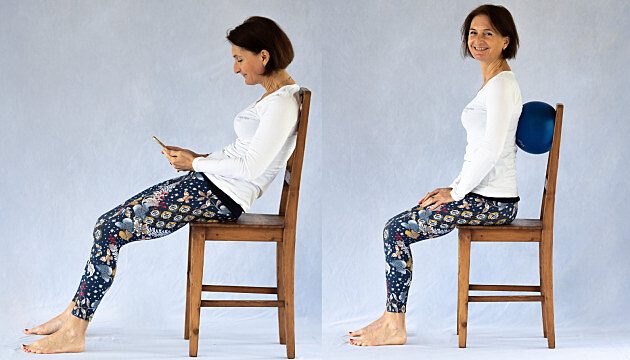
One of the functions of the fascial network is to convert compressive forces into tensile forces. The goal for a pain-free life is to create tension (a healthy pulling force) in the body, not compression (a crushing force). Tensile forces decompress the spine and joints, allowing everything to function as it should. Your body is a network of tensioned cables—muscles and fascia. When these cables are properly tensioned and flexible, they hold our joints and body segments in the correct position, preventing wear and tear during movement.
What position is your body in right now? Are you slouched? Or beautifully elongated?
For most people, "auto-elongation" simply means "straighten up!" I remember hearing that phrase countless times as a child. "Shoulders back!" was a common refrain from parents and teachers. But how did our bodies interpret that command?
Did you pull your shoulder blades together, lift your lower ribs, and arch your lower back? In an attempt to fix one poor posture, we often shift into another extreme. The instruction to "straighten up" is executed by the parts of the body that are mobile enough to do so. Where muscles are short, tight, and adhered, no movement occurs. And so, we inadvertently create new problems.
That's why, before we can work on alignment, we need to address the fascial network, stretch the shortened parts, and only then can our body lengthen in the segments where it's truly needed.
Only in an aligned and elongated state can we achieve balanced tension in our tissues, muscles, and fascia. This leads to centered joints and even weight distribution. The vascular, nervous, lymphatic, and digestive systems can then function more efficiently, and fluids can flow freely.
This is why Auto-Elongation is the second step in the FASPO movement system. But alignment isn't the final goal. Our body needs to be not only flexible but also stable and strong.
Stability Should Be the Shadow of Every Movement
A sense of physical stability and coordination also influences our feelings of stability and coordination in life.
When the body functions harmoniously and is in balance, we feel better mentally and emotionally.
Every segment and joint in the body needs to be maximally stable through every phase of movement while maintaining ideal mobility.
Stability should be the shadow of every movement. We can use gravity to our advantage when we know how to ground ourselves in it. Stability is dynamic—it's about oscillation, not holding a static pose. Forcing a position requires disproportionate effort.
If your ankle is unstable, it will affect your knee, hip, and back. Our body is only as strong as its weakest link.
How is your body positioned in space? Is your transition from one position to another coordinated and stable?
Ensuring the strength and stability of all body segments is the third step toward a pain-free body, and "S" for Stability is the third letter in the FASPO system.
You might be thinking that this is enough. Our body is now aligned, flexible, and stable. And while that's a great foundation, the reality of daily life requires more.
We perform countless movements every day, and it's up to us whether we use them to our benefit or our detriment—whether our movements heal our body or slowly break it down.
Movement Habits: Your Body's Daily Medicine

How do you hold your body when you brush your teeth, drink coffee, work at the computer, or lift heavy objects? All of these small actions have a huge impact on whether our movement helps or harms us.
For example, using a thumb-dominant grip when carrying a bag, basket, or pot overloads the shoulder and cervical spine. But if you pick it up leading with the pinky-edge of your hand, you activate the stabilizing muscles of the shoulder blade, and the shoulder opens beautifully. There are hundreds of tricks like this. By incorporating them into your daily activities, you'll suddenly find that your pain disappears. Movement, when done correctly, heals.
This is why I founded the School of Movement Habits, which guides people in relearning the everyday movements that have shaped humanity for millions of years. It offers a perfect opportunity to practice these foundational movements in daily life without setting aside extra time.
- Impulse training for the pelvic floor while walking, standing up, or climbing stairs helps with back pain.
- Every time you stand up is an opportunity to ensure proper knee alignment.
- Looking to the side can mobilize your thoracic spine.
- A brisk walk opens up the groin and hips.
- Reaching for something on a high shelf in the kitchen mobilizes your shoulder joint.
- Driving with both hands on the steering wheel improves shoulder stability.
Embracing natural movement in everyday life is the secret to a pain-free existence.
Therefore, cultivating proper Movement Habits (Pohybové návyky) is the fourth step of the FASPO system.
Breath Is Movement
Breath is the final pillar. Breath is movement. In fact, it's the movement our body performs most frequently. Breath happens. It flows where it has space—where our body allows it. If a part of our body is tight or collapsed, the breath has no chance. It's ineffective to force breath where there is no space or elasticity. That's why I've placed breath as the final step in my therapeutic movement system, FASPO.
- F – Fascia Care
- A – Auto-Elongation (Alignment)
- S – Stability & Strength (Spirals)
- P – Posture & Movement Habits
- O – Oxygen (Breath)
By working with the body on all these levels, it becomes flexible, aligned, and stable. It begins to move according to the foundational patterns we were born with, and the breath can finally flow freely into the spaces we've created.
Every cell in our body needs oxygen. But for oxygen to be released from the blood and enter the cells, it requires the right kind of breath.
How are you breathing right now?
A free and natural breath flows into the body through a slow nasal inhale as the diaphragm moves down.
The air slowly enters the body, filling the chest:
- Beneath the collarbones: The shoulders widen and lift slightly.
- Between the shoulder blades, to the sides, and forward: The ribcage expands like an accordion.
- Into the lower back ribs, the sides of the waist, and gently into the solar plexus.
- Into the lumbar spine, the sides, and gently into the belly.
- Into the pelvis: Widening as it opens the hip bones and releases the SI joint.
- Into the pelvic floor.
This gentle pressurization of the entire torso, from the pelvis to the neck, lengthens and slightly braces the entire spine. The individual vertebrae separate, decompressing the intervertebral discs, while the short muscles along the spine lengthen and activate.
Then, the inhale seamlessly transitions into a nasal exhale. The diaphragm rises like a piston, creating a vacuum in the abdomen.
- The pelvic floor rises.
- The abdominal wall gently contracts.
- The chest and intercostal space narrow.
- The shoulders gently lower and widen.
- And the spine continues to lengthen, as if you were wearing a royal crown.
After the exhale, there is a moment of calm repose. From this stillness, the next inhale is born.
I recommend practicing this mindful breathing several times a day. The more often you do, the better it is for your body.
Only then will your cells receive:
- Sufficient oxygen: Preventing muscle stiffness.
- A gentle massage for your internal organs.
- Support for your spine and shoulders from the breath itself.
- Relief for tight trapezius muscles.
- Diaphragmatic assistance to the heart, helping it pump blood to the lower limbs.
- Activation of the parasympathetic nervous system, which relaxes the body.
- Positive changes at a hormonal level.
- Up to 19 times more energy.
I explain how to work with your body comprehensively using the FASPO system in my practical lecture, FROM PAIN TO JOY.
So, does it all make sense now? Do you understand why simply strengthening your abs won't fix your back pain? Or that your knee pain might be caused by tight thigh muscles or the way you stand up from a chair?
Our body is a brilliantly interconnected system that requires comprehensive care. And that is exactly what the FASPO movement system offers. It's a recipe for a pain-free body. Just follow these five steps, and movement will stop being a source of pain and instead become your medicine.
Wishing you beautiful, pain-free days filled with movement.
With respect for the body and its connections,
Tags
#Fascia#fascia#Axial Elongation#Stability#movement habits#breathing#back pain#Movement Therapy