Movement & Health
What Is a Truly Functional Core? (Hint: It’s Not About a Six-Pack)
5. dubna 2023
6 min read
Updated 4. 6. 2026
MF
Martina Fallerová
Movement & Wellness Expert
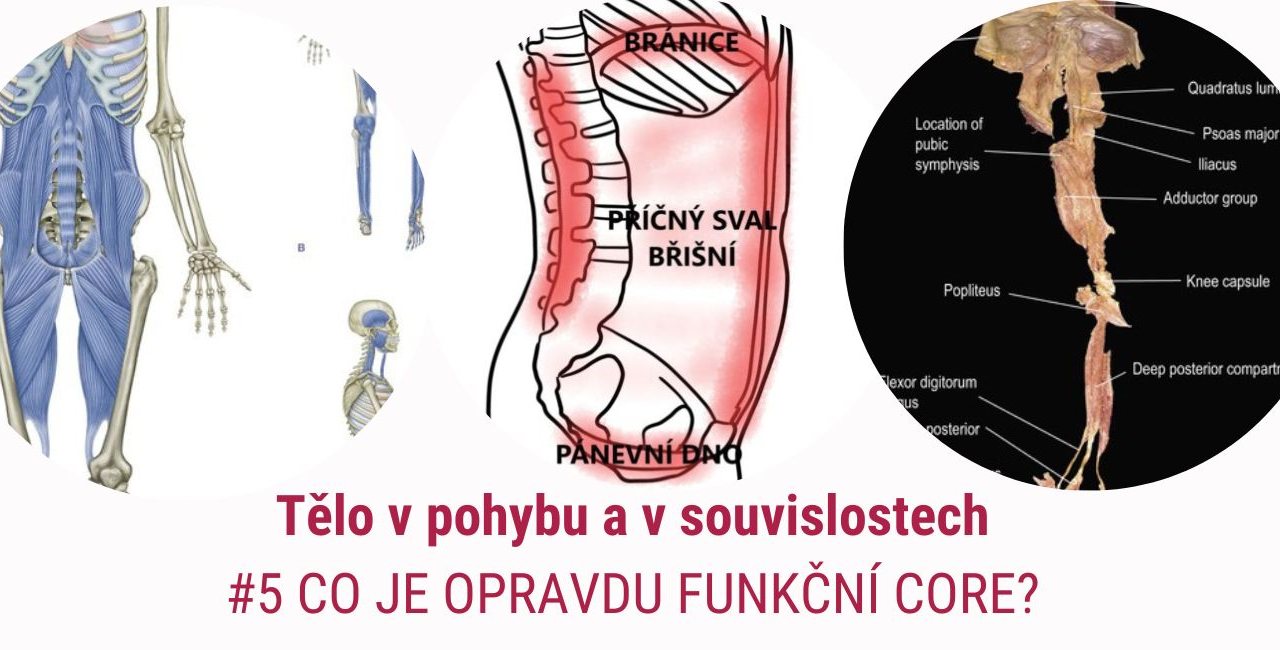
Everywhere we read, hear, and are taught that if you have back pain, you need to learn to breathe into your belly and train your CORE—also known as the Deep Core Stabilization System (DCSS).
But what if there's more to the story? Let's take a deeper dive.
The Textbook Definition of the "Core"
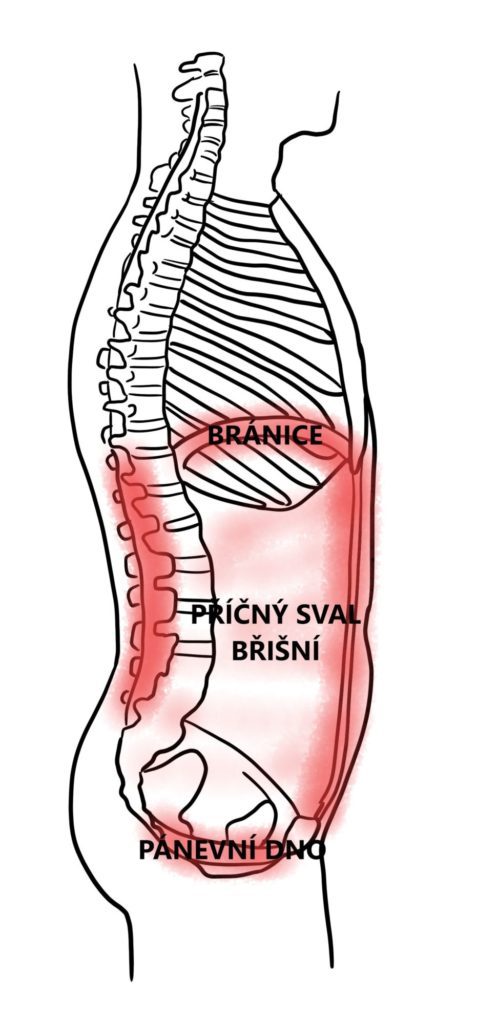
In schools and training academies for movement instructors, we learn that the Deep Core Stabilization System (DCSS) includes:
- The pelvic floor muscles (diaphragma pelvis)
- The transverse abdominis muscle (musculus transversus abdominis)
- The small muscles in the deepest layer along the spine (musculi multifidi)
- The diaphragm
A Missing Link in the Chain
When we look at the typical diagram of these muscles, we see that they are located in the middle of our body.
But this model raises some critical questions:
- Where is the connection to the lower limbs, which anchor us to the ground?
- And where is the connection to the chest, head, and upper limbs that we use throughout the day?
The truth is, we are not just an abdomen. We are a 3D spatial network connected by fascial tissue—a concept that many experts still overlook. This tissue forms a vast, three-dimensional web that ensures everything in our body holds together while also allowing for smooth, gliding movement.
Muscles Are the Engine, But Fascia Is the System
While muscles provide the power for movement, it's the fascia that ensures coordination, transfers strength, and provides stability to our joints.
Think about building a house; it can't stand without a strong and solid foundation. Every machine must be firmly anchored to work correctly. When I look at the traditional diagram of the DCSS, it looks like the second story of a house, completely disconnected from its foundation.
My Question Is: Why Do We Treat the Human Body Differently?
Why, when it comes to the human body, do we ignore the feet and the lower limbs?
Why hasn't this theory been updated with modern research on fascia, muscle slings, and fascial chains?
To find the answer, let's explore the Deep Front Line.
The Deep Front Line: Our True Inner Core
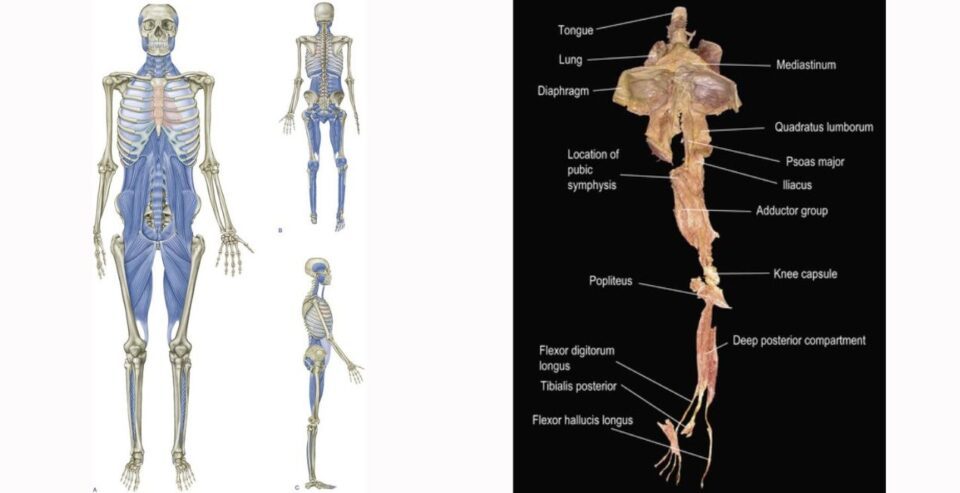
The Deep Front Line (DFL) is a three-dimensional space that fills the deepest parts of our anatomy. It provides profound stability to the body and connects this structural support with our organ systems. It’s like the core of an apple.
This line of muscles and fascia runs from the soles of the feet up through the calves, thighs, pelvic floor, hip muscles, and diaphragm, continuing all the way to the chewing muscles, the floor of the mouth, the tongue, and even the membrane separating the cerebrum and cerebellum.
What Does the Deep Front Line Do for Movement?
The DFL is responsible for a vast array of stabilizing functions throughout the entire body:
- Lifts the inner arch of the foot.
- Stabilizes every segment of the leg, including the ankles, knees, and hips.
- Integrates with the pelvic floor.
- Supports the lumbar spine from the front (a key function of the iliopsoas).
- Encloses and shapes the abdominal-pelvic cavity, from the pelvic floor to the diaphragm.
- Stabilizes the chest while allowing for the expansion and contraction of breathing (the "respiratory wave").
- Balances the cervical spine and stabilizes the heavy head from the front.
A lack of activation in this deep line can manifest as a weak foot arch, unstable ankles or knees, a dysfunctional pelvic floor, hip joint pain, pelvic collapse, or a shortened, compressed posture—sinking into oneself, a pattern often seen in depressive states. It can also lead to a forward head posture, an open mouth with a dropped jaw, and poor breathing patterns.
This deep fascial line stabilizes every joint in our body and participates in movements in all planes. The fascia here is denser, and its associated muscles contain more slow-twitch (red) fibers, which are built for endurance and are responsible for postural control and the fine-tuning of our body's segments.
From all this, it's clear to me that the Deep Front Line is our TRUE FUNCTIONAL CORE. Therefore, exercises should be comprehensive and always strive to connect our entire body into an integrated whole. This is why training only the traditional "core" muscles can't lead to the permanent elimination of back and joint pain.
The Link Between Posture, Metabolism, and Breathing
These slow-twitch muscle fibers of the Deep Front Line also have a more energy-efficient metabolism. This is due to their rich vascular supply, high number of mitochondria (the "cellular powerhouses"), and myoglobin (which transports oxygen).
These fibers function primarily through aerobic activity (with a supply of oxygen). Because they primarily use fat for fuel, their energy source is practically inexhaustible, providing long-term, steady muscular work at a low intensity. At higher intensities, the body would start using energy from glycogen. This means that slow-twitch muscle fibers are essential for maintaining an upright posture, body alignment, isometric contractions, and stabilizing joints and bones.
But what happens if we don't breathe through our nose? If the tongue, instead of supporting the upper jaw, falls back into the throat, and our diaphragm is weak and dysfunctional?
When this occurs, our tongue no longer provides support to the maxilla. Oxygen cannot be effectively released from hemoglobin into the muscles because the necessary carbon dioxide is missing for this process. Furthermore, the absence of nasal nitric oxide means blood vessels don't dilate properly, and as a result, our muscles are poorly supplied with oxygen.
Is it any wonder we feel pain? Do your knees, hips, lower back, or neck hurt? Are you gaining weight? Are you constantly tired?
I Love the Detective Work of the Human Body
I truly love finding these connections and playing detective within our own bodies.
It's time to restart your system. Discover the true strength and stability of your body, ground yourself, and open up to a life of movement without pain.
I would be thrilled to guide you through this transformation in my online course, RESTART YOUR BODY.
<figure>
<a href="https://martinafallerova.cz/prodej-online-kurz-restartuj-sve-telo/">
<img src="images/38-1024x576.jpg" alt="A woman stretching outdoors, promoting the 'Restart Your Body' online course.">
</a>
<figcaption>
<a href="https://martinafallerova.cz/prodej-online-kurz-restartuj-sve-telo/">https://martinafallerova.cz/prodej-online-kurz-restartuj-sve-telo/</a>
</figcaption>
</figure>Tags
#Core Stability#Fascia#Back Pain#Anatomy#Posture#Breathing