Back PainBreathworkFasciaFunctional Core
How to Relieve Lower Back Pain, SI Joint Dysfunction, and Body Tension
15. dubna 2025
10 min read
Updated 4. 6. 2026
MF
Martina Fallerová
Movement & Wellness Expert
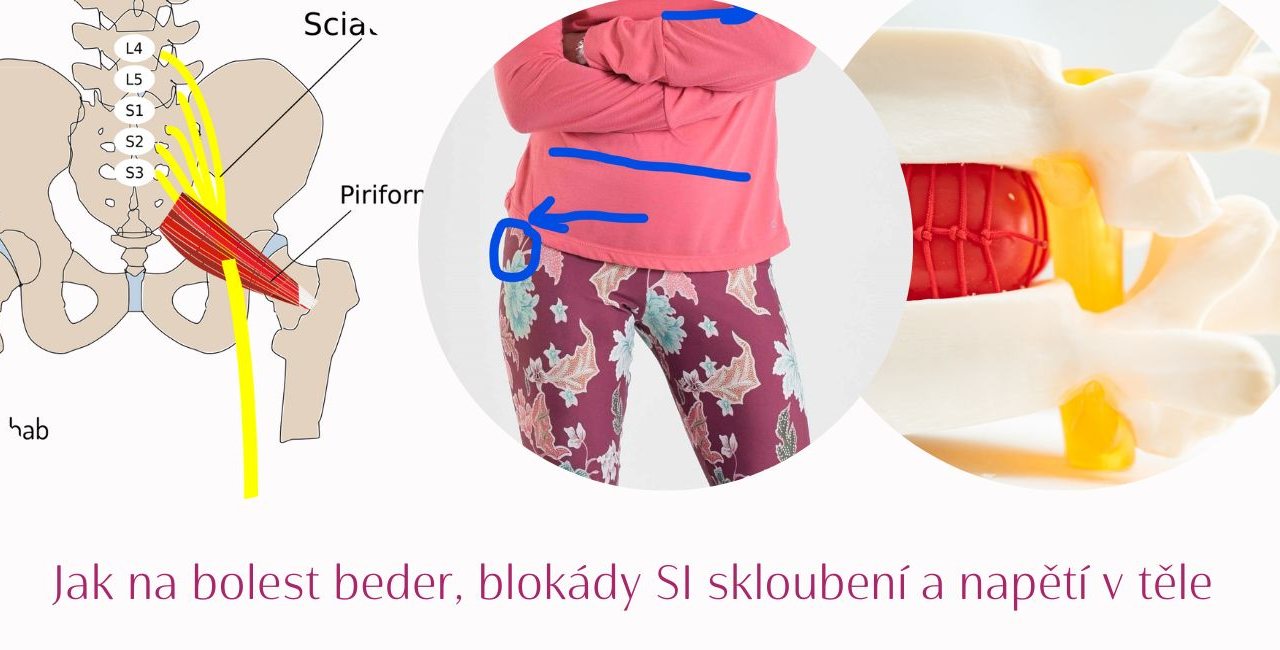
I received an insightful question about dealing with persistent SI joint blockages, lower back pain, significant tension, and pain radiating from the lower back down into the leg. The query mentioned the context of demanding physical work involving constant bending, menopause, insomnia, and the related hormonal shifts. Let's take a comprehensive look at this complex issue.
Protecting Your Spine When Bending
When we talk about protecting the spine, it's crucial to use the strength of your legs, not your back. The correct way to bend involves several key principles:
- Push off from your feet.
- Initiate the movement through your knees and rotate your pelvis at the hip joints.
- Keep your spine elongated, maintaining balanced tension between your abdominal and back muscles.
- Avoid constantly rounding or flexing your back.
When we repeatedly bend forward with a rounded spine, the intervertebral discs are compressed, creating a tendency for them to bulge or herniate. If this forward-bending motion is not counteracted by an opposite movement (extension), the disc is gradually pushed outward.
At the Yoga&Fysio Fest, I had the opportunity to attend a lecture by a physiotherapist specializing in the McKenzie method. She had a beautiful model of a skeleton with a cutaway of a disc, which clearly demonstrated that when the spine flexes, the nucleus of the disc migrates outward.
The Proper Technique for Bending and Lifting
It’s important to realize how often our bodies must compensate for certain movements. For example, mothers and grandmothers are constantly bending down to small children or picking things up off the floor. We sit with rounded backs and sleep curled up in a ball. These positions and movements are often never properly compensated for.
Piriformis Syndrome and the Sciatic Nerve
When we are constantly bending forward with a rounded back, something in the posterior chain has to hold the body up to keep it from falling. This role is often taken on by the gluteal muscles and the external hip rotators.
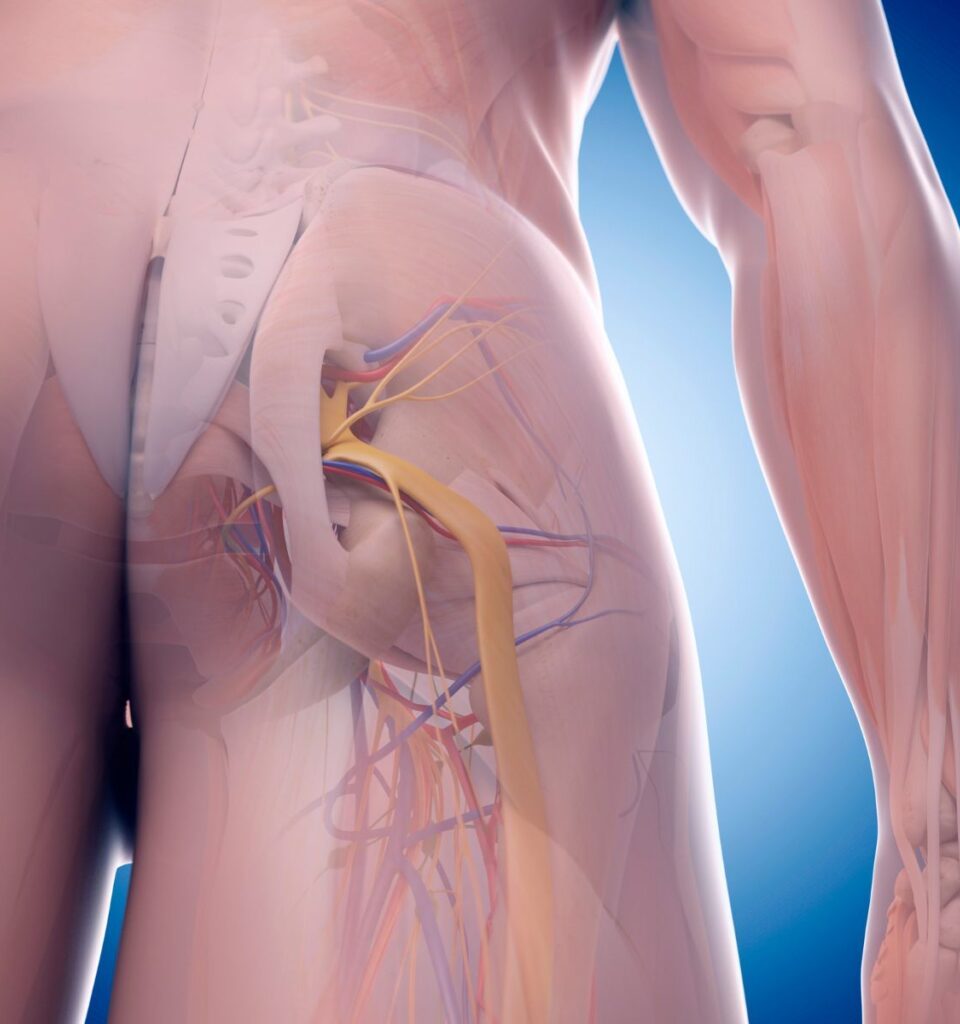
Piriformis syndrome is well-known today, but it's often overlooked. The sciatic nerve, which originates from the lumbar spine, runs beneath these external hip rotator muscles. It’s a thick bundle of nerves that later branches out.
The Path of the Sciatic Nerve Varies Slightly in Everyone:
- Sometimes it passes underneath the external hip rotators.
- Sometimes it passes directly through them.
- Sometimes some fibers pass underneath while others pass through.
When we have tightness in the deep gluteal muscles, every movement creates a pull on the sciatic nerve. This is especially true when there's a lack of fascial glide and hydration, which would normally allow the different layers of tissue to slide smoothly past each other.
The result is that any movement—whether it's moving the leg or bending forward—causes a tug on the sciatic nerve, which runs from the lower back all the way down the leg. This is why we can feel pain, particularly if there is also a herniated disc present.
These pulling forces can even misalign the vertebrae, shifting them out of their proper position. That's why it's crucial to avoid bending sideways. Always face forward, keep your spine straight, and bend through your knees and hips.
Why Does the SI Joint Hurt?
Pain and blockages in the sacroiliac (SI) joint are related to an overall imbalance in the body. Key factors include:
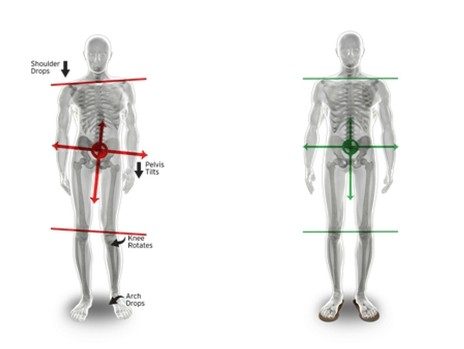
- Movement habits
- How we stand and sit
- Where and how we "hang" on our joints
- Head position, especially if it's consistently off-center
Many people today seem to be "missing their glutes." The gluteal muscles are essential for stabilizing the hip joint and the SI joint, and they act as a counterpart to the hip flexors (iliopsoas). The interplay between these muscles is fundamental. We cover all of this in my online course, Restart Your Body.
So, Why Does the SI Joint Actually Hurt?
If we consider the anatomy, our spine has a specific structure. The vertebrae end in the sacrum, which is shaped like a wedge. On one side is one pelvic bone, and on the other side is the second.
Here’s how the body can collapse under pressure:
- Forces and pressures act downward.
- The wedge (the sacrum) gets pushed deeper between the pelvic bones.
- The pelvis tends to widen at the bottom.
- The sit bones move apart, creating pressure on the SI joint.
- The alignment of the hip joint changes.
- Imbalanced tension in the pelvic floor and external hip rotators also affects the SI joint.
We often stand by "hanging" on one hip, causing it to shift out of alignment. The head of the femur is no longer well-covered by the socket. This creates pressure in the SI joint, and eventually, everything starts to hurt. The entire spine can shift into a scoliotic posture, including the joint where the head meets the neck.
The Importance of Breath for a Healthy Back and Overall Wellness
Breath as a Stabilizer
The breath is always a crucial component when dealing with lower back pain. It is key not only for stabilization but also for influencing a wide range of bodily processes.
You can find more articles about breathing on my blog.
The Power of Proper Breathing
- It stabilizes the lumbar spine.
- It influences our nervous system (switching between sympathetic and parasympathetic states).
- It creates space between the vertebrae.
In my programs, Restart Your Body and Body Without Pain, we focus extensively on breathing because it's a powerful tool that's always available to you.
Breath and the Nervous System
When we activate the parasympathetic nervous system, which calms us down, our breath moves into the lower lobes of the lungs. The diaphragm descends, and we tone the vagus nerve. This process soothes the entire body.
This is especially important for overcoming insomnia, a state where the body doesn't get a chance to regenerate. We know that breathing patterns can worsen dramatically during menopause. I personally tape my mouth at night to ensure I breathe functionally through my nose, allowing my cells to get enough oxygen and my body to regenerate properly.
An important note: The moment we focus too intently on our breath and try too hard to control it, we create pressure on ourselves, and the breath won't function as we need it to. The key is to be gentle.
Other Strategies to Release Tension and Support Your Body
Self-Massage and Rolfing Techniques
To release tension in the body, we can use self-massage tools like:
- A foam roller
- A spiky massage ball
- A tennis ball
These techniques are part of my online course Restart Your Body.
The Interplay of Breath and Stress
Breath influences stress, and stress influences breath. As soon as we become aware of our breath and calm it down, we shift into the parasympathetic (rest-and-digest) state.
Fascia and Nerve Endings
Chronic stress tightens and affects the fascial system. When these connective tissue coverings are constricted, it's important to remember that 80% of our nerve endings are located within the fascia.
If the fascia is dehydrated, these nerve endings become irritated. For proper hydration, you should:
- Drink at least 1.5 liters of fresh water daily.
- Ideally, choose spring water.
- Consider using structured water.
Lifestyle Adjustments for Better Sleep
Our bodies need sleep to regenerate. Cheating yourself out of it is never worth it in the long run.
Here are some lifestyle measures for better sleep:
Calm Down and Connect with Your Breath:
- Take time to quiet your mind and focus on your breathing.
- Release physical tension throughout your body.
- Transition into a meditative state.
- Consciously let go of tension with each slow exhale.
In addition, you should adjust other environmental factors:
- The most restorative sleep is said to occur before midnight.
- Get sunlight first thing in the morning to signal to your body that it's daytime and to kickstart cortisol production.
- Dim the lights in the evening.
- Be mindful of who you spend time with (and avoid toxic interactions).
The Anti-Inflammatory Diet
Do you exercise consistently, yet your body still aches? In our bodies, everything is interconnected, and your diet could be the culprit. Industrially processed foods, unhealthy fats, sugar, and stress take their toll. You might be dealing with high cholesterol, asthma, arthritis, or vascular disease, all of which can be traced back to chronic inflammation in the body (which, unfortunately, isn't routinely measured).
Omega-3 fatty acids from fish oil are key. But be careful—standard fish oil oxidizes quickly, so your body can't use it effectively unless it contains polyphenols from olive oil to protect it. Most common supplements don't meet this standard, meaning you might be wasting your money.
A note on inflammation: Inflammation is a natural part of the healing process, but we also need a "brake" in the form of anti-inflammatory compounds. That's why it's essential to eat:
- Fresh foods
- Minimally processed meals
- High-quality olive oil
- Polyphenols and other antioxidants
There are several types of Omega-3s, but most scientific research focuses on three.
The Main Omega-3 Fatty Acids Are:
- Alpha-linolenic acid (ALA)
- Eicosapentaenoic acid (EPA)
- Docosahexaenoic acid (DHA)
Of these three, EPA and DHA are the most important for our health.
Alpha-linolenic acid (ALA) is used by the body to produce EPA and DHA. However, the conversion of ALA to EPA is inefficient, so it's necessary to increase your intake of EPA and DHA directly.
The Best Sources of Alpha-Linolenic Acid (ALA) Are:
- Flax seeds
- Chia seeds
- Hemp seeds
- Walnuts
However, as mentioned, the body is not very effective at converting ALA into EPA and DHA. For this reason, you need to consume EPA and DHA directly from fish and seafood.
The best sources include:
- Mackerel
- Herring
- Salmon
- Anchovies
- Sardines
- Seafood and sea algae
Foods High in Omega-6 (to limit):
- Vegetable oils (sunflower oil, corn oil, margarine)
- Industrially processed products (frozen meals)
- Fried foods
- Cured meats
- Salty snacks (corn chips, potato chips)
In Conclusion: Observe Your Body with Kindness
Every body is different and requires slightly different inputs. It's important to start tuning into yourself, observing what's happening, and gently intervening. Play with your body joyfully.
It's not about grinding through intense workouts, but about becoming an observer of what makes your body feel good. Give it your attention. Perhaps that’s what’s missing most—we ignore our bodies, and they no longer know how to tell us what they need.
Let's try to be observers, acting with kindness and gentleness.
With love for the body in motion and all its connections,
Martina
Tags
#back pain#fascia#movement habits