Uncategorized
A Step-by-Step Guide to Healthy, Pain-Free Hips
13. prosince 2019
6 min read
Updated 4. 6. 2026
MF
Martina Fallerová
Movement & Wellness Expert

Is Your Hip Joint the Hidden Cause of Your Back, Knee, or Foot Pain?
Are you struggling with lower back pain? Do you have issues with a knee or a bunion? The culprit might just be your hip joint. I know HOW to fix it >>>
Our bodies are designed for movement, and this is doubly true for the hip joint. Consistent, varied movement is the only way to maintain a full range of motion and ensure proper blood flow and nutrition to the tissues surrounding the hip.
The Problem with Our Modern, Sedentary Lifestyle
Today's sedentary world is incredibly damaging to our hips. We sit at work, in the car, and at home in front of the TV, computer, or tablet. We move less and less, and as a result, hip-related problems are now appearing even in younger generations. A limited range of motion, one-sided strain, poor movement patterns, and athletic overuse are often the root causes of degenerative conditions affecting not just the hips, but the entire body.
To avoid ending up on a waiting list for a hip replacement, we need to think consciously about our movement and take proactive steps throughout our lives. You are responsible for your own body. The neglect we show our bodies today is something we can't make up for in the future.
The Hip Joint: An Evolutionary Marvel
Thanks to evolution, we transitioned from supporting ourselves on four limbs to standing on two—our lower limbs. This freed up our upper limbs, allowing us to interact with the world and perform complex tasks. To make this happen, our pelvis had to rotate 90 degrees over the hip joint. This joint is one of the largest in our body, responsible for transferring forces from our legs to our torso and back again. It is also one of the last joints to fully develop and, unfortunately, one of the first to age.
A newborn baby's hip joint is not yet fully formed; after all, it spent nine months flexed in the mother's womb. Proper maturation and extension require movement. From kicking their legs, lying on their stomach, rolling over, crawling, and cruising along furniture to finally walking, every stage is essential. Walking is particularly crucial, as it involves both extension during the push-off phase and flexion during the stepping phase. Other activities like climbing walls and jungle gyms, which utilize a full range of motion and even hanging upside down, are also vital for healthy development. The hip joint doesn't fully mature until around the age of 9-10, when a child's permanent teeth come in.
Understanding the Anatomy of Your Hip
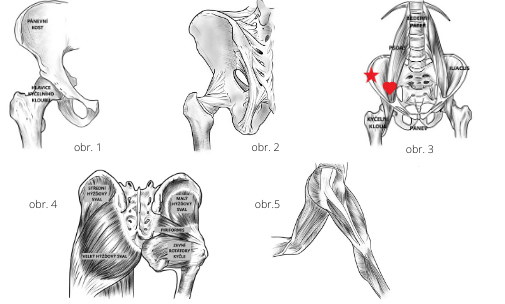
The hip joint is the connection between the femur (thigh bone) and the pelvis. It consists of a socket (acetabulum) in the pelvic bone and the head of the femur, which narrows into a "neck" that allows for a wide range of motion. As a ball-and-socket joint, it can move in all directions. The femur and pelvis are the most robust bones in the human body.
A strong ligament runs from just above the socket, over the head of the joint, and attaches to the neck, stabilizing the hip. This ligament prevents the body from tipping backward with every step. It is relaxed during flexion (bending) and taut during extension (straightening the leg behind you), which gives it immense strength.
For every step we take, we rely on a powerful muscle—the hip flexor, or iliopsoas. This muscle connects the lumbar vertebrae and the pelvis to the inner side of the femur. When used correctly, it externally rotates the thigh and knee slightly during flexion and prevents an excessive arch in the lower back (lumbar lordosis). However, due to our sedentary lifestyle, this muscle often becomes tight and inelastic, frequently causing that sharp, shooting pain in your lower back when you stand up quickly after prolonged sitting. When standing, it also prevents our torso from falling backward.

The Muscles That Support Your Hips
From the back, the hip joint is stabilized by three gluteal muscles and a group of five external rotators beneath them. The function of the hip is also influenced by the interplay of muscles on the front, back, inner, and outer sides of the thigh. The balance between all these muscles determines the position of the femoral head within the socket and, therefore, the overall function of the hip.
The moment these muscles fall out of balance, the hip joint is no longer centered, leading to wear and tear on its contact surfaces. Stiffness, lack of elasticity, or dysfunction in the muscles and fascia around the hip also impacts the function of the entire leg, including the knee and foot.
A Functional Hip Is Key for a Pain-Free Body
Focusing on a functional hip joint is crucial for anyone suffering from pain in their back, neck, knees, or even from bunions.
The health of your hip and knee joints is directly dependent on how your feet function. Everything is interconnected. One part cannot work properly without the others.
Learn HOW TO manage your Feet, Knees, and Hips. Learn to walk correctly. Learn HOW to help yourself overcome problems and pain, and HOW to adjust your daily movement habits to achieve a fully functional hip joint.
LIVE – WORK – PLAY Without Back and Joint Pain
My E-book: HOW TO Fix Your Feet, Knees, and Hips – Learn to Walk Properly is waiting for you >>>
However, if you want to eliminate hip pain and problems once and for all, you need to bring your entire body back into balance and functionality. This is the only way to ensure the problems don't return. If there's an issue in your hips, your entire lower limb—from the foot up—won't function optimally. The transfer of forces to the pelvic floor and core will be uneven, and this dysfunction can travel all the way up to your head and upper limbs.
That's why I created a unique online video course - RESTART YOUR BODY. In this course, we first release tension using self-massage tools, then we work on restoring the optimal length of muscle and fascial structures, and finally, we strengthen everything into a functional system and integrate it into your daily movement habits. I look forward to seeing you in the course!
You can find more inspiration in another blog post: Shoes or Barefoot? Let's Walk Softly and Silently Like a Cat.